[!TIP] Try it out! You can explore the interactive version of the capstone project on the Scout Lab. NOTE: This feature is currently gated.
Live App & Exercise Access: Interactive tools in this track (such as the live Scout interface or spatial evaluation tools) are not yet public. If you would like to test these applications, please reach out to the author.
Overview
Scout is the capstone project of this curriculum — a "Chat-to-Map" application that combines STAC, DuckDB, and LLMs to answer natural language geospatial queries and render results on an interactive map. It is assembled across three phases: data ingestion (Phase 1), the LLM translation backend (Phase 2), and the full web application (Phase 3). Each phase builds directly on the last, producing a working end-to-end system by the final module.
Key Concepts
1. The Scout Architecture
Scout is structured as three sequential phases: Phase 1 builds the ETL pipeline that fetches Overture Maps data, filters it to San Francisco, and writes a spatially-optimized GeoParquet file alongside a STAC catalog. Phase 2 builds the API route that converts a natural language query into executable DuckDB SQL using an LLM. Phase 3 assembles the Next.js frontend with MapLibre GL JS and DuckDB-Wasm to render results in the browser.
2. Chat-to-Map: How a Question Becomes a Layer
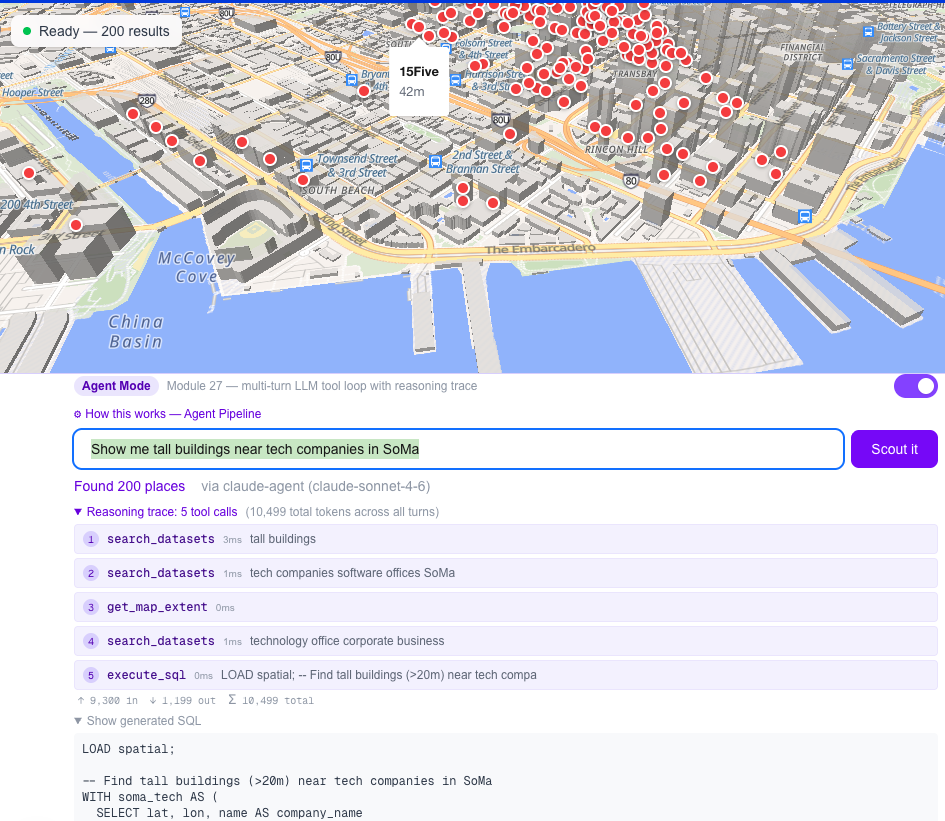
When a user types "show me coffee shops near Dolores Park," the Scout API route injects the STAC catalog (schema + closed category vocabulary) into a system prompt, calls an LLM to generate a DuckDB SQL statement, and returns that SQL to the browser. DuckDB-Wasm then executes the query directly against the GeoParquet file hosted on S3 using HTTP range requests, and MapLibre renders the results as point markers — no server-side query engine required.
3. The Role of Each Key Technology
STAC provides the data contract: a machine-readable catalog that describes the schema, bounding box, and category vocabulary so the LLM can generate accurate SQL without hallucinating column names. DuckDB-Wasm moves query execution into the browser, eliminating any always-on backend database. The LLM (Anthropic Claude or OpenAI GPT-4o, swappable via an environment variable) handles natural language understanding and SQL generation.
1. The Goal
User: "Show me all coffee shops in San Francisco within 500 metres of a park."
Scout will:
- Understand the intent using an LLM.
- Translate natural language into a spatial SQL query.
- Execute that query directly in the browser using DuckDB-Wasm.
- Visualize the results on an interactive map instantly.
2. Why This Matters for Product Patterns
The Scout lab embodies three forces reshaping the geospatial product landscape:
- Zero backend cost: The only infrastructure is a static file host (S3/R2). No always-on database server, no tile server, and no compute bill that grows with your user count.
- Latency-free UX: Once data is cached in the browser, every filter and query runs on the user's own CPU. No network round-trip means interactions feel instant. This is a quantifiable product differentiator: interactions under 100ms are perceived as immediate.
- Natural language as the interface: Hiding SQL behind a chat bar makes complex geospatial analysis accessible to non-technical stakeholders. This pattern powers Felt AI, Esri's ArcGIS Instant Apps, and Google Maps' conversational search.
- Auditable queries: Because the output is a standard SQL string, every query is inspectable, loggable, and reproducible. This level of transparency is essential for compliance and data governance.
3. The Stack
| Layer | Technology |
|---|---|
| Framework | Next.js 15 (App Router) |
| Styling | Tailwind CSS 4 |
| Basemap | MapLibre GL JS |
| Data overlay | Deck.gl: GeoJsonLayer |
| Browser database | DuckDB-Wasm (httpfs + spatial) |
| ETL | DuckDB Python |
| Data source | Overture Maps (S3, 2024 release) |
| LLM (swappable) | Anthropic Claude or OpenAI GPT-4o |
4. Next Steps
The project continues through three more modules, each one building directly on the last:
- Data Sourcing & ETL: Query Overture Maps on S3, filter to San Francisco, write spatially-optimized GeoParquet, and generate a STAC catalog describing the output.
- Semantic Translation Backend: Write the Next.js API route that converts a user's question into a valid DuckDB SQL string using a swappable LLM.
- Web App Assembly: Integrate the final Scout UI with MapLibre GL JS, DuckDB-Wasm, and Deck.gl for the "Chat-to-Map" experience.
Practical Exercises
Scout Intro is the architecture and design module — the exercises live in each subsequent phase. Reading through the stack table and the architecture diagrams here gives you the mental model you will need to work through Phases 1–3.
Exercise files coming soon.